

On the Workings of the Imaginal in Astrological Chart Reading
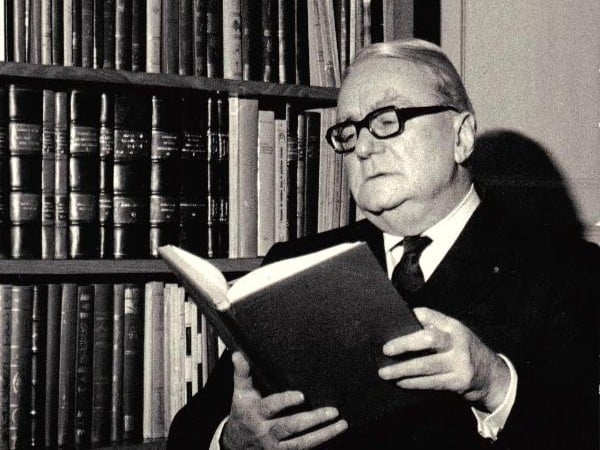
(Picture: Henry Corbin, 1903-1978: Philosopher, Theologian and Expert of Ancient Islamic Sufism)
The beauty of the imagination lies in its lack of certainty
(James Hillman)
How the astrologer acquires knowledge
The history of astrology has produced two very different – and to my mind, contradictory – traditions. The first tradition in astrology focuses on the visible reality of the cosmos and on the relationship of cosmic cycles with events on Earth. In this tradition, it is clear how the astrologer obtains knowledge, namely by observing these cosmic cycles and making connections with phenomena here on earth.
The second tradition in astrology focuses not so much on the visible cosmos, but on an inner experienced connection to the cosmos (via astrological symbolism). In this tradition, in which many modern astrologers place themselves consciously or unconsciously, the answer to the question of how the astrologer obtains knowledge is less easy to answer.
In this article, I explore astrological knowing in this second tradition: what does the astrologer’s connection with the inner cosmos entail? The focus is on a form of human knowing that may play an important role in the application of astrology: the capacity for imagination.
The Mundus Imaginalis: the world of images
If we (can) embrace the idea that imagination gives us access to a certain reality, it is interesting to explore the nature of this reality. Several thinkers in the 20ecentury, such as Henry Corbin, Carl Gustav Jung and James Hillman, have developed interesting insights on this, often based on ancient knowledge. By far the most important insight to emerge from their research is that the world of images is much more than a reality created in our heads: it is an autonomous reality.
The implications of this insight are hard to underestimate. As modern, Westerners, we tend to think that the things we imagine are our own and arise in our heads. These thinkers argue that there is an autonomous reality of images. Corbin calls this reality the Mundus Imaginalis (the imaginal world or world of images), a name he derives from the 12/13th-century Sufi teacher Ibn Arabi. The basic idea is that the Mundus Imaginalis is an intermediate reality that connects two other realities, namely the material reality, which we as humans can perceive with the senses, and the purely spiritual reality, which can be described as fully transcendent or divine. Just as the soul forms the connection between spiritual and material existence, the Mundus Imaginalis forms the connection between invisible and visible reality
There are differences of opinion on exactly what this reality looks like. According to Corbin, who was religious, this reality is populated by spiritual beings, especially angels, who, among other things, act as helpers and mediators between the two worlds. Hillman adopts a more psychological perspective. Rather, he sees the world of images as the home of the human soul. However, the core in both approaches is the same: the reality of images is autonomous and not a product of the human mind. Corbin and Hillman do not deny that, in addition, there is such a thing as human fantasy, but more on that in the next section.
Hillman somewhere gives the example of the following two experiences: seeing a fox in the forest versus seeing a fox in a dream. The fox in the forest will be regarded by most people as an external reality, the fox in the dream is regarded by many people as an internal, personal reality: an imagination/creation of one’s own mind. Hillman questions this distinction and asks us: could it be that the fox in our dream is also an external reality? This way of looking at things turns the modern worldview on its head, because the dream fox is then no longer a ‘fantasy’ in our heads, but an autonomous reality with which we as humans can enter into a relationship.
Imagination as the soul’s power of perception
If the Mundus Imaginalis is an autonomous reality, how can we come to know this reality? This touches on the question of what the nature of imagination is. Modern definitions do not help us here, because they assume a materialistic worldview and thus have no conception of spiritual realities. For example, the Cambridge Dictionary defines imagination as the ability to create ideas or images in your mind (‘mind’).
It is important to distinguish imagination from fantasy. In this view, they are essentially different functions in the soul. Hermetic philosophy offers a perspective on this duality. In this philosophy, human beings are equipped with dual souls. The higher, rational part of the soul has the potential to know Divine reality, it forms as images originating from the source of life. Imagination in this part of the soul involves direct and pure seeing or knowing. The lower, astral part of soul, which allows us to live in a body, imagines through the senses.
Imagination as a higher form of knowing is a form of inner, subjective knowing, because the Mundus Imaginalis is a spiritual reality. This form of knowing is opposed to objective knowledge, which we base on external realities we perceive with the senses
Here we encounter a very relevant distinction for astrologers, namely that the human soul, the vehicle of imagination, is a layered reality that can connect with both material and spiritual realities. This produces different kinds of imagination. The soul can imagine new forms based on sensory impressions. However, this activity is of a substantially different order from the soul connecting to a higher spiritual reality.
The first form of imagining involves (re)arranging existing forms. As humans, we do this in many ways: for example, by fantasising about something, by colouring the reality we perceive with our previous experiences, emotions, ideas and beliefs, but also by creating new forms (works of art, houses, etc.). If, for the sake of convenience, we limit reality to all the things we can perceive sensually, there is -logically speaking- nothing in this reality that comes about without prior imagination. So even the visible cosmos is the product of imagination.
The second form of imagining is what Corbin and others talk about when they talk about the Mundus Imaginalis. Here, contact is made with a higher, spiritual reality that shows itself to the soul through (personal and collective) images. This reality is autonomous. So the images here are not a product of the human mind, but autonomous realities with which humans can connect on an inner level.
Hillman calls imagination the essence of the soul; he sees it as the core of a process he refers to as soul-making. According to him, the soul is not a fixed entity, but a developing spiritual reality that is shaped and evolves through experiences in matter (Jung calls this individuation). Imagination is the soul’s instrument that provides meaning to human experience. Myths, fables, fairy tales, as well as astrological symbols, can be considered universal images in the Mundus Imaginalis.
Imagination as an active ingredient in astrological chart reading
The most fundamental question asked of astrologers is: how does it work? In light of the above, we can flesh out this question: how do we as astrologers distinguish between A) an astrological insight we receive from the astrological Mundus Imaginalis and B) our own mental fabrications, e.g. the keywords we creatively reproduce from ‘The Astrology Textbook’? If we can answer this one, the logical and equally important follow-up question is: how do we do this? In other words, what is needed to receive the messages from the Mundus Imaginalis in the best possible way?
Recognising the Mundus Imaginalis in astrological chart reading
Philosopher and astrologer Geoffrey Cornelius uses a distinction that most astrologers will recognise. He talks about speculative versus realised astrological chart reading. In speculative astrological chart reading, the astrologer gives more or less general interpretations of the horoscope symbols. In realised astrological chart reading, there is an unfolding of meaningful astrological images in (the mind of) the astrologer.
There are crucial differences between the two forms of astrological chart reading. Speculative interpretation is at its core an active mental process in which existing knowledge about astrological symbolism is reproduced in a more or less mechanical way. In principle, this process can be planned. A skilled astrologer can in this way arrive at astrological knowledge that will lead to much recognition on the part of the horoscope bearer.
Realised astrological chart reading presupposes that the astrologer connects with the astrological Mundus Imaginalis and retrieves knowledge from it. This knowledge is received (as in: inwardly heard, seen, felt or known) rather than mentally produced. This process is less planned and therefore more surprising: astrological symbolism unfolds before the astrologer. Perhaps the most important difference: the insights from the Mundus Imaginalis are a form of living knowledge: they touch the soul at a deeper level: meaning is experienced rather than correct knowledge. These insights open access to consciousness and move the soul, prompting it to develop, to act. Astrological insights are similar in this sense to the truth that people can experience when hearing music, reading a poem or meeting a human being: in all cases, these are experiences that may have a deep impact on the soul.
The astrologer enters the Mundus Imaginalis
Corbin seems to suggest that there are no recipes for entering the Mundus Imaginalis. Hillman, see the quote above this article, points us to the fact that we can never say with certainty where the images, in our case the meaning of astrological symbols, come from: from our personality or from a higher, spiritual source of knowledge. Despite this uncertainty, there are, in my opinion, some aspects that can be pointed out in the basic attitude of the astrologer that either hinder or stimulate connecting with the Mundus Imaginalis.
It seems to me that the first and most important precondition for establishing this connection is that the astrologer is aware that there is such a thing as a Mundus Imaginalis and that communication with this world transcends one’s own ‘mental production’. If this awareness is not there, a lot of psychic energy will usually go into what the astrologer has to ‘do or don’t do’ to arrive at a good interpretation. After all, the assumption then is that it all comes from the person himself (the personality or lower soul). Many problems that (aspiring) astrologers experience with reading astrological charts lie, in my opinion, in this area, namely in the overestimation of one’s own role in the interpretation. This takes many forms in practice, but uncertainty about whether one’s own knowledge is adequate is especially common.
The astrologer who is aware of the autonomous reality of the Mundus Imaginalis knows that it is important to approach chart reading in a receptive and receiving manner, otherwise the symbolic messages cannot be properly heard, seen, felt or known. For this, it is important that the voices of the personality (who wants to do well, wants to be sure, is anxious, etc.) take a back seat as much as possible. However, awareness of the Mundus Imaginalis will not deliver the astrologer from the tendencies of the personality. Each astrologer can investigate for himself which tendencies are involved and how they hinder the higher soul’s receptivity to the Mundus Imaginalis. This will always be ‘work in progress’.
Sources
An important book by Corbin is Creative Imagination in the Sufism of Ibn ‘Arabi (later published under the title Alone with the Alone). Some fascinating titles by Hillman are Re-Visioning Psychology, The Thought of the Heart and the Soul of the World and The Alchemy of Psychology. Tom Cheetham is a contemporary author who has written widely on this subject. More information on his work can be found here: https://www.tomcheetham.com/ . The website of the Centre for Myth, Cosmology and the Sacred provides access to some articles by Geoffrey Cornelius on the nature of divination: https://mythcosmologysacred.com/geoffrey-cornelius-work/.
PDF File

Social Media