

An Ancient Perspective on Soul-centred Chart Interpretation
What is Hermeticism?
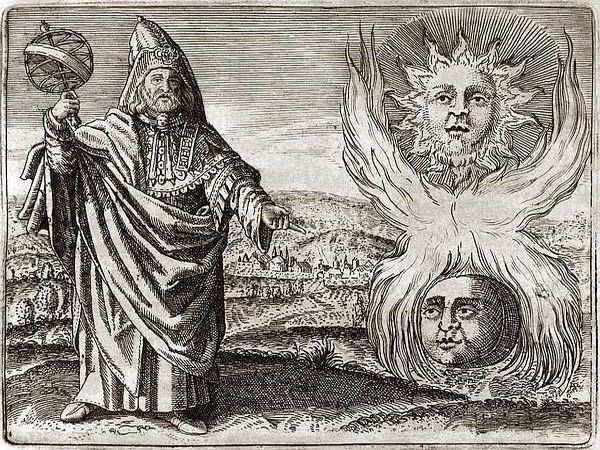
Every astrologer knows it and works with it: the adage that what is lower is equal to what is higher, that man as microcosm is a reflection of the macrocosm. These images come from the Hermetic texts (also called: Hermetica).[1] The Hermetica comprises a collection of wisdom texts attributed to Hermes Trismegistus. Of him we know little more than that he was ‘thrice great’ and possessed the wisdom of all things in the world.
There is a collection of classical Hermetic texts believed to date back to Egyptian times. Many of these texts take the form of a dialogue in which a teacher teaches and initiates a student into the secret (read: spiritual) aspects of life. Traces of Hermetic thinking, sometimes called eternal wisdom, can be found in many religious and spiritual movements, such as Christianity and Blavatsky’s Theosophy.
In terms of content, the texts can be roughly divided into three types: there are texts that describe how the world was created and what its (spiritual) laws are, there are texts that stimulate the reader to develop as a spiritual being (soul) and there are texts that translate the principles of Hermeticism into concrete application, such as magic, alchemy and astrology.
No single worldview emerges from Hermeticism. Those who study these texts encounter numerous contradictions. Those who look beyond these contradictions discover the spiritual core of Hermeticism: the message that man has a Divine origin and can discover this reality in himself. The Hermetic texts have served since time immemorial as a source of inspiration and signpost for the disciple who wants to open up to this.
Hermetic cosmology
The Hermetic world view can be summarised as follows: reality, i.e. everything that is, consists of an uncreated part and a created part. The uncreated part is equivalent to God. This reality is incorporeal, unlimited, non-dual and eternal. Creation consists of the cosmos and within it, referred to as a separate entity, man. Everything in creation is characterised by duality: the opposition between matter and spirit. The soul connects these two realities. This is the life-giving principle.
Both the cosmos and man are considered in Hermeticism to be animated realities. However, there are two important differences between them. The cosmos represents an eternal movement, man a temporary one, the latter being mortal after all. A second difference is that man is equipped with a different kind of soul from the (rest of the) cosmos. Both kinds of souls are divine, but only the human soul is rational, i.e. it has the capacity to know God. Free will resides in this part of (evolved) man. All other phenomena in the cosmos lack this soul aspect: the Sun, for example, cannot decide not to rise for a day. In the cosmos, everything proceeds according to the laws of necessity. Man, because of his materiality, is also subject to this. The idea in Hermeticism is that the rational soul enables man to transcend these laws of necessity. The Hermetic texts provide the ‘tools’ for this.
Thus, on the one hand, through his material existence, man is subject to the laws of the cosmos (such as space and temporality), but on the other hand, man possesses the spiritual ability to transcend these laws. He can do this only when he makes himself equal to God. In daily existence, this means that the soul detaches itself from identification with earthly matters and focuses more on its spiritual origins.
Hermeticism and astrology
For modern astrologers, especially those who favour a soul-centred perspective on chart interpretation, it is quickly apparent that Hermeticism and astrology are a match made in heaven. After all, the practice of astrology fits seamlessly with the worldview in Hermetica, which is based on the idea that all manifestations in creation are a variation on an underlying spiritual reality (unity). It is this unity that astrologers make use of when looking at planetary and star positions to say something about events on earth.
In texts on the history of astrology, we read that Hermeticism has always been a major inspiration and starting point of astrology. I take the liberty of dismissing this claim as nonsensical. In astrological texts since ancient times until well into the 19th century, the word soul is virtually absent. Incidentally, this also applies to astrological texts that are considered Hermetic. We should note here that hardly any ancient Hermetic astrological texts have survived. These have been largely lost. In what has been preserved, such as the Liber Hermetis, for example, the soul plays no significant role[2].
If there is one main line to be distilled from two millennia of astrology, it is that the focus is on the inevitable fate that takes place in the material reality: living, dying, love, war, harvests, starvation, etc. The focus of astrology has long been strongly materialistic and deterministic. Perhaps the highly influential work of Ptolemy (1st/2nd century AD) contributed to this. This astrology focuses on the visible cosmos, which can be perceived with the senses. This ‘scientific’ approach to astrology is at odds with the Hermetic approach, here the inner experience of oneness is the starting point. In material reality, the cosmos is something outside or above man; in spiritual reality, cosmos and man are intrinsically connected. Man is able to discover this interconnection of things; the astrologer uses the cosmic cycles for this purpose.
The crucial role of the soul in this cosmology
Since spirit and matter are opposing realities according to Hermeticism, a unifying principle is needed that holds both realities together. This is the soul, also called the vehicle of spirit. The soul has a dual nature, the higher or rational soul, is the aspect of the soul that expresses the spiritual will, the lower or astral soul regulates the astral functions that take care of maintaining the dust body. The rational part of the soul is considered immortal, the astral part of the soul dissolves when the body dies.
The sage dissolves Fate. He is neither under the Coercion nor subject to the cosmos, but he is above heaven, his mind is above visible things.
(Didymus The Blind, Commentary on Ecclesiastes 167, 15-17)
The astral soul is supposed to function lawfully, just like the cosmic cycles, of which this part of the soul is a reflection. That is, there is no freedom in these soul functions: whoever is hungry must eat, whoever is tired must sleep, etc. This does not apply to the rational soul: as an expression of the divine will, this part of the soul possesses a spiritual capacity that allows it to discover its divine nature and the creative power present in it. Life on earth encourages man to develop this capacity. According to Hermeticism, the soul can be free from the laws of nature only when it becomes aware of its spiritual origin. The Hermetic astrologer investigates and supports this process of awareness.
The dual nature of the soul makes it constantly move in two directions: from spirit to matter and vice versa. On the one hand, spiritual realities are transformed into material realities; on the other, spiritual realities are created through man’s actions. We can find this process in everyday life on numerous levels: the realisation of a building structure is always based on a prior idea about that structure (from the ‘architect’). The structure itself, however, also creates consequences in the spiritual sphere: it influences ideas for future builidings, for example.
For Hermeticists, all the functions in the human soul, i.e. the mental will, rational judgement, feeling functions and action, are necessary for fulfilling its role on earth. Man’s task lies in putting the lower soul functions at the service of the higher (rather than vice versa).
Below, I will show by means of two examples how this kind of insight can be translated into astrological interpretation. It should be noted that no cookbook approach is possible, as it assumes materialistic and deterministic thinking.
Principles of Hermetic chart interpretation
The Hermetic astrologer will be guided in astrological interpretation by (among others) the following principles:
- Cosmic cycles lead lawfully to (spiritual) evolution and growth in consciousness
- Man is the instrument for this, due to the fact that he is equipped with a rational soul. The cosmos ceaselessly provides man with experiences that help him develop awareness of the spiritual plan underlying creation and invites man to contribute to this spiritual plan with the creative power that is within him
- The growth in consciousness has no end point, spiritual evolution is infinite
- The relationship between man and cosmos is not fixed
- Unconscious man experiences the laws of the cosmos as fate, man who develops consciousness learns to see it as an instrument for spiritual growth
- Celestial bodies are animate and have a dual function (to spirit and matter)
- Like humans, celestial bodies are animated realities. Like the human soul, they have material and spiritual inclinations and potentials
- The further heavenly bodies are removed from the earth, the greater the spiritual potentials and the more pervasive their effect
- This follows from the fact that the spiritual permeates the material and the higher the lower.
- ‘Recently’ discovered planets such as Uranus, Neptune and Pluto (thus) reach out to humans for new spiritual growth opportunities
- In Hermeticism, the world of the fixed stars is the resting place of the human soul: a purely spiritual reality
- The more invisible the celestial bodies are to man, the more hidden their spiritual effect
- Following on from the above: invisibility indicates unconsciousness. The visibility of previously invisible celestial bodies reaches out to man with new spiritual potentialities. The fully conscious human can see ‘all that is’
Summing up the above: in Hermetic chart interpretation, the emphasis is on the spiritual potentialities of the heavenly bodies, on what they can contribute to the growth of consciousness (through man). This is astrology as support for the Hermetic adage: ‘He who knows himself, knows all’. The focus here is not on all things personal (man’s temporary reality), but on the reality that actually transcends these dimensions.
Two examples of Hermetic chart interpretation
For all horoscope factors, it is possible to examine the orientation of the soul. Here, by way of illustration, we look at the elements and the planets.
The Hermetic interpretation of elements
The classical arrangement of the elements, from high to low: fire – air – water – earth, reflects the Hermetic worldview: the highest principle, fire, is the spiritual, light- and life-giving principle, the lowest element is the form in which this spiritual life principle expresses itself: the physical vehicle. The intermediate elements air and water represent the dual soul: the higher (rational) and lower (astral) soul principle.
For each of the elements, it is possible to examine the (dual) orientation of the soul:
- Fire: on which does the spiritual (will) power focus?
- The matter-oriented soul focuses this force on realising personal desires. The spiritually developing soul puts this force at the service of a higher reality than the personality: ‘not my will, but thy will be done’.
- Air: What does the thought life focus on?
- The matter-oriented soul creates thoughts that emphasise the separations in everyday reality, e.g. the thought ‘you are a different person from me’. The spiritually developing soul creates thoughts that emphasise the unity between the distinct parts, e.g. the thought ‘you and I are both an expression of humanity’.
- Water: What are the lusts and desires focused on?
- The matter-oriented soul will focus them on realising personal (bodily) needs. The spiritually developing soul will seek to direct its desires towards the spiritual force awakening in the higher soul (the God Spark).
- Earth: What is the action focused on?
- The matter-oriented soul will focus on personal desires that connect it (more deeply) to matter, such as possession, power, honour and the like. The spiritually developing soul will focus on desires that transcend the person and in which higher spiritual ideals resonate.
In practice, of course, this involves a complex interaction between the elements, with both higher and lower soul principles constantly at work. Hermeticism is not about ‘getting rid’ of lower soul principles. Nor is this possible, as they serve to sustain life in a body. Rather, the focus is on the orientation of the soul.
Take for instance the relationship between fire and water. Modern astrologers, following Jung, talk about the intuitive and feeling function in humans. Hermeticism teaches us that these are mirror realities. Just as the Moon reflects the light of the Sun, the water element reflects the fire element (‘so above, so below’ applies everywhere). Intuition and feeling are difficult for many astrologers to distinguish, and in common parlance these terms are also used interchangeably. Yet they involve very different functions: willpower as an expression of fire indicates a very different principle from, say, desire or longing as an expression of water. The former indicates a spiritual principle, the latter indicates a matter-bound principle. Yet they are also an extension of each other: desire in man (the pleasure-seeking and pain-avoiding aspect in the soul) is bound to the body, but it mirrors the will power that is an expression of a spiritual principle. As a person develops spiritually (fire), personal desires (water) will begin to develop more upward: these become subservient to a higher principle.
The dual action of planets: the example of Saturn
Planets, the lords of destiny, also have a dual soul: the lower soul action is bound by the laws of necessity, the higher soul action can be uncovered by the growing consciousness in man.
Take Saturn as an example, referred to in classical astrology as the great malefic: a planet that can bring little good. In it, we see the lower soul action indicated above all. We also see this in Hermeticism, for example in the following image.
The soul incarnating on earth from the soul world is clothed with the characteristics of the seven spheres on its way down. The soul needs this attire to enter a material body. The seven spheres that form the soul’s astral garment are, of course, the seven classical planets.
It is only on incarnation in the earthly body that the spirit is clothed with all those veils. For it is simply impossible for the spirit, naked as it is in itself, to take up residence in an earthly body. Nor can such an earthly body bear such eternal immortality, a perishable body skin to skin so great perfection. That is why the spirit has received the soul as its shell. And the soul, which is divine in a sense as much as the spirit, serves the astral body. And the astral body governs the living being.
(Corpus Hermeticum X., 17)
The first planet the soul encounters on this journey is Saturn. This planet brings the soul into the confines of time and space. In this we recognise the limiting (malefic) effect of Saturn. For example, it is about the heaviness of the material body that now envelops the soul. Or about inertia, as the action of spirit is slowed down in matter. Right now, I can think of being on a paradise island in the Pacific. If I think it, I am there. But to get my body there, I have to factor in at least a few travel days. In a sense, Saturn depicts the fall from paradise: Saturn’s melancholy is the soul’s usually unconscious memory of the perfect and non-dual spiritual world from which it comes and its experience of the imperfect and dual material reality.
So much for -very briefly- the lower soul workings of Saturn. (The Saturnian types among us will no doubt recognise this symbolism.) Awakening consciousness in human beings can lead them to see Saturn’s limitations, which mainly affect the personality, from a higher perspective. This can take numerous forms. For example, a person may increasingly accept the limitations in personal life because he is able to view them from a person-transcending perspective. Or someone may discover in these limitations a task he has to accomplish in this life. Or knowledge can grow regarding the greater meaning of personal experiences. All these potentials are also present in Saturn. Only the developing human soul will be able to discern them -in varying degrees.
Saturn is particularly interesting in this context because in ancient times it was the gateway between the visible world and the invisible world. No other (classical) planet confronts the human soul so intrusively with the limitations of life in a body, but precisely because of this it also reaches out to the highest spiritual potentials. Saturn as the man with the scythe is also potentially the ancient sage, who possesses the knowledge of all times. It is up to man to discover these potencies. The Hermetic astrologer can support in the process of awakening, by offering this perspective.
In conclusion: tilting the interpretation
The above has indicated how Hermeticism can serve as a breeding ground for a soul-centred approach to astrology. Within the scope of this article, it was not possible to elaborate on more than a few examples. It is important to remember that Hermetic astrology as referred to here (i.e. modern, soul-oriented) does not involve a separate method or technique or a new form of astrology but rather is a perspective that can be combined with existing approaches to astrology. This involves consciously tilting the interpretation perspective, by focusing on the vertical, spiritual dimensions of existence rather than the horizontal, material dimensions. Perhaps the most important tilt here is the premise that humans do not have consciousness, but are part of it. This shift in perspective is a major task in our time and in our part of the world. Also for astrologers.
PDF File

Social Media