

What Venus’ Children Teach Us About The Archetype
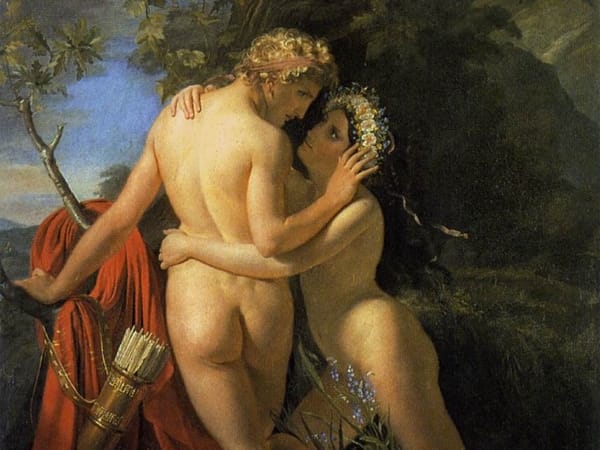
(Image: The nymph Salmacis secudes Hermaphroditus)
Love!
Astrologers look to Venus when it comes to matters of the heart. In mythology, Aphrodite (later known as Venus) appears early on with children who represent different aspects of Love. Her best-known offspring is Eros (later also known as Cupid and Amor), often depicted as a chubby baby with wings, shooting arrows. But Aphrodite’s brood is larger than that.
What do Aphrodite’s ‘love babies’ teach us about the different aspects of the Venus archetype?
Erotes: Aphrodite’s ‘babies of love’
Aphrodite’s offspring are called the Erotes, named after Eros, the best known among them. Their number varies. The first mention of them is found in the works of the Greek poet Hesiod (7th/8th century BC). He names Eros and Himeros as Aphrodite’s pair of children. Plato adds Photos to this list, thereby creating a sort of trinity. Later poets and artists added even more erotes, such as Anteros, Hedylogos, Hermaphroditus and Hymenaeus. They fulfil various roles in the service of Aphrodite.
Recurring themes can be seen in the way Aphrodite’s children are depicted. For instance, they are often winged, a reference to their spiritual origins and abilities. They are often young (babies or youths), a reference to their innocence, but also to growth. They are usually naked, a reference to the naturalness and purity of their work. Beauty is also a recurring theme: the erotes are often strikingly beautiful. The connection between beauty and love is an ancient one: Plato (5thcentury BC) remarked on this, noting that earthly beauty reminds the soul of the divine reality from which it originates. The soul’s response to perceiving beauty is a desire to connect with it.
Astrological interpretation of the erotes
As a group, the erotes play no role in astrological interpretation. We do, however, occasionally encounter individual erotes, particularly Eros. Eros, for example, is interpreted as a pars and, more recently, also as an asteroid.
We shall discuss five of the seven erotes mentioned above as specific manifestations of the Venus archetype. We shall leave Hedylogos (god of sweet words) and Hymenaeus (god of the wedding song) out of consideration, as their connection to Aphrodite is less pronounced in mythology.
Cosmic Eros: creator of new life
Before Eros appears as the son of Aphrodite, Hesiod, in his Theogony (7thcentury BC), already speaks of the god Eros as one of the fundamental forces of creation. This god, as is clear from many tales, represents a primal force that is compelling and inevitable, to which humans and even gods are subject.
Eros is the fairest of the immortal gods. He weakens the limbs and is more powerful than the mind and wise counsel of all gods and all men
(Hesiod, Theogony, freely translated)
Put simply, the primal force of Eros brings together what was separated by creation, thereby creating new life. In popular translations, this Eros is often referred to as the god of procreation, but reducing Eros to the act itself seems a gross oversimplification of the archetype. The primal force described here suggests that a spiritual law is at work in creation, uniting what is separated, and to this law the individual will of humans and even that of the gods is subordinate. This is the law of love.
Eros as a child: the powerful arrow in the heart
When Eros appears as the son of Aphrodite, we see the archetype broadening: here, Eros is not merely the primal force in creation, but his mother’s loyal assistant, serving primarily her interests (which are not always entirely pure). The element of play enters into love. Here, Eros becomes more human.
The young Eros is winged, moving high through the air at the speed of light. He uses fire arrows or burning torches with which he sets both humans and gods ablaze and awakens in them a burning desire against which no defence is possible. The references to wings, fire, light, speed and uncontrollable power point to the great spiritual force at work here, just as with cosmic Eros.
The symbolism of the young Eros is very broad, perhaps as broad as that of Venus herself. We have therefore selected a single theme: an implement with which Eros is often depicted – the bow and arrow. This is striking, as this implement resembles a weapon rather than an instrument of love.
The poet Ovid writes about Eros in his Metamorphoses: ‘from his quiver full of weapons he drew two arrows with opposing powers, one arrow that kindles love and one that destroys it’. Here we see that a dual effect comes into play in Eros: one force leads to life, the other to death.
In the symbolism of the hunt, death and life also converge: prey is killed so that the hunter may live. This raises the question: what must die to make life possible?
The dual nature of Eros perhaps touches upon the relationship between the spiritual and physical aspects of love. The first aspect manifests itself in the uniting of what is separated. The second aspect manifests itself in the reinforcement of separation. The latter can take all manner of forms, such as (in humans) the experience of rejection or forms of sexuality that are self-centred.
When it comes to sexuality, many astrologers will consider Venus in conjunction with Mars, whereby Mars represents the biological drive for procreation and Venus, through the force of attraction, brings the ‘separated bodies’ together. It is conceivable that the archetype of Eros extends here to the cooperation between these planets, but it is also possible that we are looking at different levels in the workings of Venus. Be that as it may, in much ancient cosmology the adage holds that following the spiritual law leads to life and following the material law leads to death.
Himeros: the desire of the body
The oldest known brother of Eros is Himeros. He was present when Venus was born from the sea foam. Less is known about this figure. Plato writes in his dialogue Cratylus: ‘The name Himeros (desire) is derived from that which most drives the flow of the soul. It flows with great force and clings to things, thereby violently sweeping the soul along because of the force of its current.’
Himeros is associated with the physical or sexual desire aroused by the sight of earthly beauty. This desire, which is triggered through the eyes, is an immediate reaction to an external stimulus. This stimulus causes the powerful current within the soul of which Plato speaks.
Pothos: the soul’s desire
Opposite Himeros stands Pothos, which Plato, in the same dialogue (Cratylus), describes as the longing for what is absent or elsewhere. Unlike Himeros, Pothos involves a force that arises from within and acts outwards. Pothos represents, amongst other things, the deep, intense longing for the unattainable. This longing is associated, amongst other things, with homesickness and the pain of separation.
Although Pothos and Himeros both concern desire, a clear distinction can be made. The desire of Himeros is reactive and is aroused by something external. It is characterised by fervour and excitement and manifests itself in the moment. It expresses, par excellence, a physical longing. The longing of Pothos is an inner and more enduring yearning for something that is not there. This longing has a more spiritual character. Examples include the longing for someone who is no longer here, but also the soul’s yearning for the spiritual world. Pothos is a spiritual, life-giving force that arises from the experience of separation.
Anteros: reciprocal love (or death)
Anteros is often contrasted with Eros. Whilst Eros signifies love as such, or, in a narrower sense, presides over sensual love, Anteros presides over love that is reciprocal. This god ensures that justice prevails in love, because only love that is reciprocated frees those involved from the pain of separation. Anteros is often depicted with the wings of a butterfly, which in Greek culture symbolises the soul, but also the transformation from the lower to the higher. It is the quintessential expression of a spiritual principle.
Anteros, as the archetype that brings reciprocity, is also the avenger of unrequited love. As the son of Ares (Mars), we also see a destructive force welling up within this child of Aphrodite when the laws of reciprocity are violated.
In the myth of Meles and Timagoras, the young woman Meles mocked the sincere feelings of love that Timagoras harboured for her. She drove him to his death. Anteros did not hesitate to subsequently fill Meles’s heart with both guilt and love for Timagoras. The pain this causes Meles is so intense that she, too, chooses death (Pausanias, Description of Greece,2nd Century AD).
The idea of revenge serves here to restore a disturbed balance. This can work both ways. In the material world: if love is not (or no longer) reciprocated, reciprocity is achieved by making the rejecting party experience separation as well (Venus has many creative ways of expressing this: scratching someone’s car, stalking them online, etc.). Revenge can also serve a spiritual purpose. Thus, the separation between Meles and Timagoras is resolved when both die a physical death. Anteros as the avenger prompts us to reflect on how Venus fosters connection at a deeper level.
Hermaphroditus: the end of man (and woman)
He is the child of Hermes and Aphrodite. At first he was a young man, but a nymph fell in love with him and begged the gods to unite them permanently. Thus it came to pass, and what we now call an intersex or non-binary person came into being, depending on whether we focus on the physical or spiritual dimension.
The best-known myth of Hermaphroditus comes from Ovid’s Metamorphoses (1st century BC). This myth is profoundly mysterious, because on the one hand we can argue that the Venus archetype finds its highest realisation here: the fusion and, consequently, the dissolution of the masculine and the feminine. At the same time, this is not a voluntary fusion: Hermaphroditus rejects the nymph, but she devises a ruse (by having him bathe in a spring) and even resorts to violence in order to unite with him after all. This lends the union a certain unease. After the union, Hermaphroditus asks his parents to ensure that every man who enters the spring after him ‘emerges as a half-woman and immediately weakened’. This, too, raises questions: is a desire for union being expressed here, or is the aim to weaken male competition?
Hermaphroditus traditionally symbolises the emasculated or effeminate man. We can also view it differently. In this myth, we see a struggle between the masculine and feminine aspects, which is won by the feminine aspect: union over separation. This victory leads to the abolition of the distinction between masculine and feminine. This is – indeed – the highest manifestation of Venus. To achieve this, however, a resistance within the masculine principle must be overcome. It is a feminine principle that brings this about.
In conclusion: Venus under the bonnet
In Hermetic wisdom, it is stated somewhere that a person cannot be blamed for their desires, because they are lawful: a person is subject to them and can only endure them. The myths about the Eros deities not only illustrate how lawful, but also how profoundly spiritual these forces are. So profound, in fact, that even in the seemingly destructive power of the vengeful Venus we can still discover a unifying and life-giving element. To do so, however, we must look beyond what our eyes can see: Venus clearly operates ‘under the bonnet’ of visible life.
Sources
For this description, I have drawn on texts available on ‘Theoi Project’ (https://www.theoi.com/). This website contains source texts from (primarily) Greek mythology.
PDF File

Social Media