

Introduction
Particularly among Dutch astrologers, you often come across the custom of referring to elements in the horoscope as superior or inferior. This probably stems from the popularity of the Jungian approach to astrology in the Netherlands, and from Karen Hamaker’s popular book on elements and modes. In it, she gives Carl Gustav Jung’s view of consciousness functions a practical application in astrology.[1]
Several astrologers, including Rob Hand and Hajo Banzhaf, have in the past been critical of equating Jung’s four functions of consciousness (sense perception, feeling, thinking and intuition) with the four elements,[2] arguing, among other things, that Jung himself never made an explicit connection with the elements fire, air, water and earth (which is correct) and that the content of some functions of consciousness seems at odds with the meaning of the elements as we know them traditionally. For example, Hand mentions the feeling function (water), to which Jung attributes a ‘rational’ function.
In this article, I want to show that the functions of consciousness can indeed be equated with the four elements. To do so, however, we have to delve deeper into Jung’s work, because his insights changed over time: while his initial interest was mainly in the superior element and how it develops, he later became fascinated by the generically inferior element: earth.[3] His quest is invaluable for astrologers, because the elements are not only an important aspect of interpretation in the horoscope, they simultaneously refer to the most fundamental dimensions of existence.
Psychological types and elements
The book on the four psychological types, published in 1921, belongs to Jung’s earlier work. In it, he describes that we need all four functions of consciousness to fully realise ourselves, but that, as a rule, only one of these functions is fully available to consciousness. The function that is most developed, he calls the superior function. Opposed to this is the inferior function, which, of all the functions, is the most unconscious. If the intuitive function is superior, the opposite sense consciousness function will operate inferiorly.
It is searching in ‘Psychological Types’ for the answer to the question of which of the four functions develops into superior and why. Jung’s answer seems to be that society, in particular, pushes the individual in a direction in which he or she comes to prefer one of the four functions to the others, and that function with which nature has endowed him or her most richly. Hamaker’s astrological translation is that the element in which the Sun is located is of special significance in this, which is a reason for many astrologers to designate this element as superior. My own experience is that the most strongly occupied element (looking at Ascendant, Sun, Moon and inner planets) works out superior. Be that as it may, the element with which nature blesses you the most is basically used the most, and with that function also comes the strongest identification.
Classically-trained astrologers have a problem with Jung’s representation, because in it the relationship between the elements differs from the classical Aristotle-based model (see Figure 1). In ancient times, the elements were ordered from fire (highest and lightest element) to earth (darkest and heaviest element). Aristotle named two core qualities for each element. From this, it can be deduced that fire (hot and dry) is most opposite to water (cold and moist) and air is most opposite to earth (hot and moist vs cold and dry). However, Jung emphasises the distinction between the dry elements fire and earth and the moist elements air and water. In doing so, he harks back to an ancient Hermetic tradition in which fire and earth are considered the basic ingredients of creation. In this, fire represents the spirit dimension of being and earth the material dimension. These two realities are fundamentally different from each other and unable to connect with each other, they stand alone as ‘dry elements’. The connection is established by the moist elements air and water.”[4]
This view explains why Jung calls thinking and feeling rational functions, as opposed to fire and earth which he calls perceptual functions. The term rational may seem somewhat strange when referring to feeling, but Jung is referring to the reflective nature of both thinking and feeling: there is always a reflection on and a connection to one of the two given realities. It would go too far to elaborate on this theme here, but in Jung’s rational functions we can recognise the soul that connects the divine fire with the earthly matter.
Figure 1 Different models of elements
|
Element |
Core qualities (Aristotle) |
Psychic functions (Jung) |
Level in Tetraktys |
|
Fire |
Hot and dry |
Intuiting |
1 |
|
Air |
Hot and moist |
Thinking |
2 |
|
Water |
Cold and moist |
Feeling |
3 |
|
Earth |
Cold and dry |
Sensing |
4 |
The terrestrial and cosmic quaternity
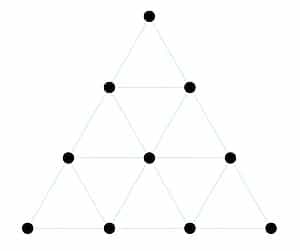
Later in his life, Jung became fascinated by the concept of quaternity (the sacred four-unity). He contrasts this with the concept of trinity (the holy trinity) we know from Christianity, among other things. The fascination with the number four is no accident; Jung here builds on ancient Greek ideas about cosmos, geometry and number theory. We can clarify his ideas by using Pythagoras’ tetraktys (Figure 2).
Behind this geometric and number configuration (1+2+3+4=10) lies an extremely rich and powerful symbolism. Among other things, the tetraktys can be used as an image of the creation of the cosmos. In this capacity, it describes how from unity (number 1 at the top) duality arises (number 2, second row) and how this duality then comes back to synthesis (number 3, third row). Number 4, the base of the tetraktys, represents material existence. Each of the four levels can be associated with an element (see figure 1): unity (or origin) is associated with fire, duality with air (hence the movement and distinctive function), synthesis with water (the connection of opposites) and material existence with earth, which is itself made up of four elements (namely the two basic dualities: cold vs hot and dry vs moist). The tetraktys shows us a horizontal, material reality that has four elements, but also a vertical, cosmological reality with four elements. In my view, the classical element theory in astrology, Aristotle’s model, mainly describes the horizontal reality of material existence.
Figure 2 Tetraktys
Earth as an element that is not ensouled
Jung was more interested in the vertical dimension, drawing inspiration from Plato’s creation story (the Timaeus). In it, the earth element is distinguished from the other three. Fire, air and water are considered elements of the triple soul in this story. According to Plato, the distinguishing feature of the soul is that it moves by itself. Fire, air and water all have movement: fire, as the lightest(er) element, is the fastest, water is the slowest of the three. The earth element is of a substantially different quality because it is inert, being moved by the other three. This element is therefore not ensouled and for this reason also enjoys ‘less status’ with Plato. For him, the reality of matter was subordinate to a higher reality in which only the soul could see: the world of spiritual forms (read: fire). Trinity was the highest attainable: the spiritual connection of opposites. This has put the element earth in a bad light, especially in the Christian tradition that relies heavily on Plato. Earth becomes the dark element. The soul that -via water- connects with matter becomes oriented towards material things, and loses sight of the higher reality. The deadly sins in Christianity, as well as the devil himself, we all find them in the element earth.
Towards the end of his life Jung’s consideration of this issue led him to the conclusion that the earth element should indeed be regarded as essentially different from the other three. According to him, it is the only element with which no access to consciousness can be obtained; for that, inspiration is needed, and it is lacking in this element. He therefore calls this the darkest element, and the sense consciousness function the most unconscious and inferior function. He also acknowledges Plato’s idea that, strictly speaking, this element is not needed to arrive at unity, since the trinity of fire, air and water is already capable of this, but at the same time he argues that the quaternity, and thus the earth element, is indispensable to arrive at a renewed wholeness from the brokenness of material opposites.
Earth, for Jung, is the alchemical vessel in which the soul’s growth processes take place. His fundamental criticism of Christianity concerns exactly this point: because the church, following Plato, sets aside the earth element as inferior, the soul cannot fulfil its task. The passage through matter is necessary to move from unconscious wholeness, the primal state, to conscious wholeness. The contradictions in material existence are necessary to reach consciousness.
The inferior earth function
Jung’s ideas on superior and inferior function show a development. His early work emphasises the emergence of the superior function, the most differentiated and elaborate function in consciousness, with an opposite inferior function. In his later work, he comes to realise that it is in the sensory function-the earth element-that we encounter the truly inferior. Our senses, functioning on the horizontal plane of the tetraktys, fall short of the vertical dimension of existence. They produce experiences of transient phenomena, but cannot gaze into higher realities.
Back to birth chart
For astrologers, Jung’s development in thinking raises fascinating questions. Such as the question of which of the four functions we can consider superior? After all, if earth is the truly inferior element, then fire automatically seems to be the superior element, even in natal horoscopes brimming with planets in earth signs. If we follow Jung’s later work, then we cannot equate a dominant earth element with superior functioning. Indeed, earth can never be the element that leads to the growth of consciousness; it is ‘only’ the vessel in which consciousness comes about. The growth process requires soul qualities, and these are found in the other three elements. So a person with a lot of earth in the horoscope takes a deep dive into material reality, but it is the elements of the soul -water, air and fire, that ‘do something’ with this.
In this process, we can consider water and air as helpers (the auxiliary elements), connecting the experience in matter with the higher reality of fire. The truly superior function, according to this perspective, we find in the latter element at all times, because it embodies the connection to the supra-material reality: the Divine, the universal, the One, light, or whatever we call this reality. Therefore, in my experience, the lack of fire in a chart results in a heavier passage through the material realm than a chart with a strong earth element, because the missing fire temporarily (i.e. during the incarnation) cuts off the soul from the supra-material reality, the source. Persons ‘without fire’, depending of course on further astrological constellations, often show a characteristic attitude to life: that of searching but unable to find. The soul apparently has an inbuilt knowledge of its own origin, but in the incarnation ‘without fire’ it does not have the tools to access it. One therefore constantly searches for inspiration and passion (or more religiously phrased: the god spark within oneself), but does not find it, the material laws dictate existence.
The implications of Jung’s later ideas for astrology are numerous and no more than touched upon in this article. I think its potential lies mainly in the fact that the vertical, cosmological dimension is much more prominent in it than in his earlier work. This shifts the focus from the psyche of man to the psyche as part of the cosmos. For astrologers who draw on Jung, this is an invitation, and ultimately a necessity, to broaden the psychological perspective on the chart to an esoteric, cosmological perspective.
Endnotes
[1] Karen Hamaker-Sunday (1979). Elements and crosses as the basis of the horoscope. Amsterdam: Bark
[2] Robert Hand (1991). Horoscope symbols, pp. 241-246. Amsterdam: Bark, and Hajo Banzhaf (1994). The four elements in tarot and astrology, pp. 198-202. Breda: Buro voor tarot.
[3] The four functions of consciousness are initially elaborated in ‘Psychological types’ (1921). By his later work, I am referring here particularly to ‘Psychology and religion’ (1938), ‘Psychology and alchemy’ (1944), ‘Aion'(1951) and ‘Mysterium Coniunctionis’ (1956). [4] This thinking goes back to Plato’s creation story in Timaeus, among others, but we also find it in the Corpus Hermeticum.
PDF File

Social Media