

Mining Gold in 2,500 Years of Written Astrology
If astrology is a language, it is the oldest in the world. Astrologers can draw on written sources dating back to well before Christ. In this series, Ben Rovers delves into the gold mine of 2,500 years of written astrology and discusses works that are too interesting to forget. They come from all currents of Western astrology. The selection is a purely personal one. The main criterion is that the work can inspire astrologers of our time.
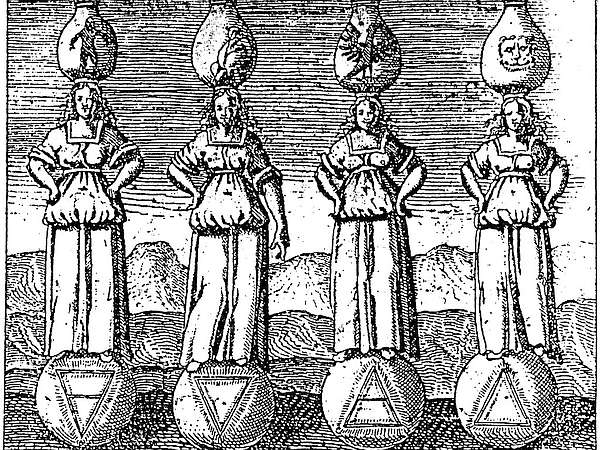
This time: Empedocles’ poem about the four elements
Why this work?
Elements are, well, rather elemental and hardly any astrologer can be found, at least not a Western one, who does not use Empedocles’ elements -fire, air, water and earth. I also know of few doctrines in Western astrology that have lasted as long as ’the four of Empo’. For me personally, the elemental doctrine harbours a great mystery, which I have been dealing with for many years. Again and again, I take ‘steps’ towards greater insight, only to discover time and again that I still have no idea.
The broader picture
As the name suggests, we are talking about an ancient Greek here, but one who lived in Sicily, then part of the Great Greek Empire, six centuries before Christ. The most famous fun fact about Empo is that he met his end in the famous volcano on the spot: Mount Etna. Jumped, pushed, who knows, but that his life ended in the highest of the elements, fire, is held by many to be historical fact. Others call it fake news.
Our protagonist, and this will surely enlighten you, was a philosopher who wrote in the form of poems. The poem we are interested in is about nature and (religious) enlightenment. From hearsay, we know that this poem originally had more than 5,000 lines. Of these, no more than about 500 remain. Not surprising, considering that the text is almost 2,700 years old. Who has 5.25-inch floppies lying around less than 30 years after the fact? (For those who don’t know what this is about: pray to the god Google and you will get an answer).
Empedocles was certainly not the first to think about elements; this was already happening before his time. There were (and are!) several element systems in circulation, naming rocks, sea, wind and ether, among others, as elemental. Elemental systems also already existed in other parts of the world, think for instance of the Chinese system in which wood and metal also appear as elements, or the elemental system in the Bhagavad Gita, in which we encounter ether, spirit, spiritual intelligence and false ego as elements in addition to fire, air, water and earth. In Japan, in addition to Empedocles’ four elements, the element of emptiness is also known. Which is just to say: the four elements of Empedocles are not alone.
Empedocles arrived at a certain systematisation of existing insights and this was picked up and further developed by Aristotle a few hundred years later. The rest is history. In the two thousand years that followed, this theory of elements remained the religious, philosophical and physical basis on which numerous disciplines could further develop, such as physics, alchemy, chemistry, medicine and also astrology. In Western science, this element system was abandoned in the seventeenth century. It was discovered that water was not a pure element, but H2 O. The birth of a new system of elements was a fact: the periodic table, which now has 118 elements. In circles of astrologers and also in other now alternative approaches, people continued to use ’the four of Empo’. After all, that these elements are impure was already known for a long time (Plato already wrote about it) and perhaps even more important: they just ‘work’.
Elemental theory is not an astrological doctrine. Astrology uses element theory, as do other disciplines. Furthermore, elements cannot be reduced to what modern chemistry does with them. That would ignore the spiritual dimension that Empedocles and others attributed to elements. Rather, element theory is a natural philosophical and cosmological doctrine. To understand what elements are about, we have to descend to the elemental level. Don’t worry, I have hung lamps.
There is no birth and death, only a change of form
Empedocles and his contemporaries asked themselves quite fundamental questions, such as this one: what is the essence of reality? ‘Fire’ said Heraclitus, because that is the highest element from which everything else arises. ‘Air,’ said Anaximenes, because in it we recognise the essence of all life: the mobile soul. Another question considered was how temporal manifestations relate to eternal ones. Parmenides had named a problem that to this day cannot be answered satisfactorily. Simply put, he said that logically, something cannot arise from nothing. So something can only arise from something else. Are you still there? Case in point: a human being is born and dies again. Fine, nothing wrong, there is joy at the beginning, mourning at the end, then everyone goes on with life (ánd death, etc.).
But where did this human baby come from? Since Parmenides, we have known that it is logically impossible for it to come from nothing. There must already be something and that something then changes shape so that it becomes a baby. Here we come close to Empo’s line of thought. He said, again in my own simple words: everything is already there. Nothing can come into being that is not already there. Everything that comes into being comes from a change of form of something that was already there. And that change in form comes about under the influence of …. take a guess….indeed: the four elements. By the way, the reverse is also true: something that is there cannot cease to exist, something cannot become nothing.
I will tell you something else: in none of all mortals is there birth and growth or an end in horrible death, but there is only mixing, and alternation of things mixed (fr. 8)[1]
Empedocles must also have looked at nature in his time and seen acorns falling from trees, which then grew into new oak trees (do oaks grow in Sicily?). He recognised a cycle in it, in which at one level there is continuous change of form – the process of birth, growth, decay and death – while at another level there is something that is permanent: the cycle itself, which is, after all, eternal. Empedocles thus found a solution to a rather fundamental paradox that can be observed in reality, namely that there is temporality as well as eternity at the same time; man coming and going is, in his view, just a mixing and separating of elements, with no beginning and no end. According to Empedocles, birth, growth and death are poor words to denote reality. The real reality, according to our protagonist, is the one in which this apparent process from birth to death takes place. And that reality is eternal and unchanging.
Deep huh? Then we can go back upstairs now, for the rest of the story. Would someone be so kind to turn off the lights again?
Love and hate, the two forces that bring together and separate elements
Empedocles from Akragas thinks there are four elements: fire, water, earth and air and that Love and Hate are their cause (fr. A49b)[2]
In hate, all elements are different in form and separate from each other, but in love they come together and long for each other (fr. 21)
Besides the four elements, Empedocles distinguishes two powers: love and hate. The first power connects the elements, the second separates them. Hate is the mechanism that also led to the creation of elements, that is, the world of temporal phenomena we perceive as reality, and love is the mechanism that brings and keeps these elements together, because without love, separated things cannot come together. Empedocles frequently speaks of Aphrodite (Roman: Venus) when talking about the law of love. We do not encounter Ares (Mars) in the surviving lines of poetry, but it seems logical that he contrasts these two Gods to denote the two basic forces in the universe.
Although he does not say it in so many words (in the remaining lines of poetry), everything points to the fact that Empedocles regards love as a force that has a spiritual (read: divine) origin, while hate is a force that emanates from matter. This is important for astrologers, because it points out to us that while elements are the building blocks of material reality, in these building blocks there are not only material forces at work, but also spiritual ones.
At various points in his poem, Empedocles describes how the phenomena of the temporal world (humans, animals, plants, etc.) are created from a unique mix of elements. He compares the Creator to a painter, who puts different dyes on the canvas in a unique mix, creating diverse scenes. He also gives specific descriptions, as the following quote shows:
Empedocles says that the flesh arose from the four elements, mixed in equal amounts; the sinews from a mixture with a double portion of fire and earth; the nails of the animals arose from the sinews, when they were joined with air and then cooled; bones consisted of a mixture of two parts water and earth and of four parts fire; sweat and tears arose in this way: the blood melted and flowed out because it became thin (fr. A78).
Each element has its own task, value and character, according to Empedocles. That the elements are not present everywhere in equal measure does not seem to be a problem for him. Consider the metaphor of the painter: a painting does not have to include all colours (in equal measure) to be beautiful and harmonious. Empedocles seems to suggest that the specific mix into which the elements are cast in a human creature has a purpose, namely to create a very specific mix of experiences. Thus, in this view, there is never a shortage or excess of one element or another. The mix is just right.
The great mystery of interaction between elements
Empedocles points us to a great mystery to be found in the interaction between elements. To get a feel for this, let’s take an analogy from nature: the water cycle. You probably remember it from school. By heating up the sun, seawater is carried up through the air and evaporates, after which it moves to land, where it rises and cools and falls back down to earth as rainwater. There it then fertilises everything that wants to grow and flourish, after which the water eventually flows back to the sea. This process repeats itself endlessly. I assume you have appreciated the elements in this analogy.
The water cycle example clarifies a number of things Empedocles says about elements, which I will summarise here:
The coming together and separating again of the elements is a permanent process, it goes on forever. Each element has its own place in the cosmos, to which it returns when it separates from other elements. This is the natural place of the element: the highest and lightest element is fire (in our example the sun), the lowest and heaviest element is earth (in our example: the planet earth), under fire we see air and under air we see water. Exactly like in nature. This ‘explains’, for example, why fire that is under the earth seeks a way out and especially up through volcanoes, which is, after all, the natural place of fire.
According to Empedocles, the elements furthest apart are the most hostile to each other. So these are fire and earth. Aristotle later called the qualities of these elements hot and dry versus cold and dry. They do not mix because they are opposite to each other (hot versus cold), but also because they are dry.[3] To mix, you need moisture, and we find this in air and water, the intermediate elements. According to Aristotle, these too are opposites, namely hot and cold, but their moist nature allows them to establish connections with other elements. In the water cycle, we see how air transports heat from the sun to the earth, where it heats water that then rises towards the sun, but then -as it begins to cool down- is drawn back towards it by the earth’s gravity.
Elements that are alike attract to each other, says Empedocles. Aristotle also elaborated this more systematically later. In our example: air that cools becomes water, but somewhere in that water air characteristics remain (H2O, wink wink) and air is naturally hot and wants to rise towards its natural place (under fire). Similarly, earth particles are also present in the water that rises, which become heavier when cooled and make their way back to earth, their natural place in the cosmos.
The logical follow-up question might then be: what a fuss, what’s it all for? This brings us to the mystery as well as the importance of Empedocles for astrologers of our time. Spoiler alert: I’m not going to solve the mystery, I’m just going to point to it (also an honourable task). Those of you who paid close attention in school know that an interesting transformation takes place in the water cycle: salt water becomes fresh in the process and fresh water becomes salty again.
In the dialogue Timaeus, Plato outlines the intermediate elements air and water as the higher and lower parts of the soul dwelling in matter (earth), but irradiated by a life-giving spirit (fire). In the scant surviving texts of Empedocles, we do not find such an elaboration, but we do find the idea that in the elements a spiritual (divine) force is active (Love), connecting things.
[We cannot bring the divine] close to us, so that it is accessible to our eyes, or grasp it with our hands, although by that route conviction most effectively penetrates people’s thinking (fr. 133).
This quote tells us that for Empedocles, sensory experience is a means by which man can come to know God. This process is through thought, the higher ‘soul element’ air through which man can grasp the divine (element of fire).
Final thought: significance for our times
Time for the final thought. What can we do with Empedocles in our time? Quite a lot, I tend to think. Empedocles makes us reflect on the fundamental building blocks of our reality, from which everything in the world of phenomena is constructed. A first, important insight, I think, is that while the elements are the building blocks of substance reality on earth and in the cosmos, they cannot be equated with it. Indeed, according to Empedocles, a spiritual force can also be discerned in elements, which makes what is separate come together again. This explains, for instance, why our hero, following Pythagoras (who died six years before Empedocles was born), was a vegetarian and a pacifist: eating meat and violence are actions that turn the soul towards matter, and thus towards the law of hatred, which separates everything.
Therefore, you, delusional of heavy to bear wickedness, will never deliver your spirit from woeful sorrow (fr. 145)
The duality in the working of elements (a force that brings together and a force that separates) causes all phenomena in reality and also the dynamics of what we are used to calling ‘life’ and ‘death’. This dynamic is the great mystery that Empedocles points out to us and to which many generations after him have turned their attention. Just think of all those alchemists in the Middle Ages who tried to turn lead into gold, raw matter into pure matter, salt water into fresh water.
What contemporary astrologers can learn from Empedocles, and I would call this the second, important insight, is that elements are not so much characteristics as phases in a continuous process of mixing and separating. By looking at elements in terms of characteristics (fire is hot, light, fast, passionate, inspired, earth is shapely, inert, cold and heavy) you miss the crucial dynamic aspect. E.g. fire heats and dries with which it connects. This allows water to evaporate and becomes air. In other words, water becomes more like fire under the influence of the action of fire. However, the reverse is also true: if more water is added to the bond with fire, the water will cool and moisten the resulting air, causing it to cool, condense and become heavier again. The process of mixing elements can thus move in two directions: earth can become more like fire if fire is dominant in the mix with earth. However, when earth is dominant, fire will become more like earth. Think of a fire: if fire is dominant, the element earth dissolves into smoke (hot air rising), if earth is more dominant, we find at most a smouldering mass (hot earth). Heraclitus, a contemporary of Empedocles, spoke the following famous but also cryptic words:
The way up and down is one and the same (Heraclitus)
My thought here is that he is talking about this process of mixing and separating elements. Think of how our thoughts (air) colour our experiences in matter (earth) and how these experiences can in turn lead to new thoughts (via the impressions we gain from our experiences: water). In this dynamic, which is different for each person because of the unique mix of elements, we find nothing less than the miracle of life.
In answer to the great Why question, Empedocles seems to formulate the following answer:
For in relation to what is at hand, people’s understanding grows (fr. 108). For with earth we discern earth, and water with water, with air the radiant sky and sparkling fire with fire, Love with Love and Hate with abominable Hate (fr. 109).
Empedocles seems to suggest here that with our unique mix of elements, we gain experiences in the material world that can contribute to spiritual growth. The paradox is that the power of hate (the force that separates) helps us become aware of the power of love (the force that makes everything one again).
I will make a twofold announcement: for sometimes they (the elements, BR) grow together, so that out of more they become one single thing, then again they grow apart, so that out of one they become more. Fire, water, earth and the endless air, and separated from them, but in every way [against them] advancing pernicious Hatred, and in them Love, in length and breadth [their] equal (fr.17)
Want to know more?
For this article, I used a fine Dutch-language edition of Empedocles’ poem, provided with context and biographical notes by Rein Ferwerda (1997). Empedocles. Earth, air, water and fire. Amsterdam: Athenaeum – Polak & Van Gennep. A newer edition (2006) is available from Damon Publishers in Eindhoven. This includes some new fragments not previously attributed to Empedocles.
There is extensive academic discussion of Empedocles’ work. A good starting point is https://plato.stanford.edu/entries/empedocles/.
Endnotes
[1] Numbering fragments based on Dielz-Kranz (1961).
[2] Quote from Aetius (1 /2ee century AD) on statement by Empedocles.
[3] As an aside, in Hermeticism, fire is associated with spirit and earth with dust. In that doctrine, these are opposite realities. The first is light, eternal and unchanging; the second is dark, temporary and changing.
PDF File

Social Media